


The Land of Golden Sunshine was a story Swami Kriyananda wrote when he was a young man, and then finally published 60 years later. He called it the most autobiographical thing he had ever written, and that’s even including The New Path, his literal autobiography.
A group of Ananda actors, dancers, and singers, led by Marcel, recently performed this little gem—the first time it’s been done here in years. This new arrangement included many of Swamiji’s songs, woven seamlessly into the story. Our small dance troupe of Rita, Karen B., Suman, and Sneha also added original choreographies, both as angels and as storm lords. Detailed sets and intricate lighting work added the finishing touches to a beautiful and powerful production.
Here’s a gallery of photos, plus a full video of the show:
(And just for an extra bit of fun, here’s a video of the 1992 production of the same play!)
Ananda Family News
Showing posts with label Theater. Show all posts
Showing posts with label Theater. Show all posts
Friday, June 10, 2016
Thursday, March 24, 2016
Healing Waters: Bernadette of Lourdes
This year’s Living Wisdom School play was their 23rd annual production, presenting the life of Saint Bernadette of Lourdes.
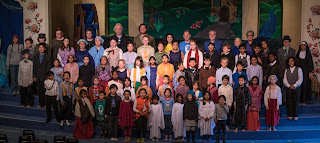
 Bernadette was a poor, uneducated peasant girl, living in Lourdes in the 19th century. When only a teenager, she beheld a vision of a beautiful lady in—of all places—the town dump. Though no one else could see these visions, they continued for a few weeks, and even in the face of severe opposition and interrogation by city and church officials the holiness of these occurrences shown through.
 It’s a short story, and Bernadette spend much of the rest of her life in a convent, leaving very little “plot” on which to base a full play. But that simplicity allowed for a greater focus on Bernadette’s actual experiences of the Divine, and also illuminated one of the qualities that make the LWS plays into magical experiences themselves.
 It’s hard not to love all the children on stage, and every single student in the school is involved, from kindergarten through 8th grade. The little ones are so adorable, the older ones so beautifully sincere, all of them putting everything they’ve got into their performances. The opening of the heart that we strive for in all our devotional and meditation practices is a natural, automatic reaction with children.
 In any other, secular, school play, we may adore the children, but there’s nowhere further to take our devotion. What makes an LWS play special is that it also offers us something sacred. We open our hearts to the children, and a vision of the Virgin Mary enters along with them. And there were times that you would swear the actors were seeing her. That’s when it truly becomes “Theater Magic.”
Keep an eye on the LWS Vimeo channel, where the video will be posted once it’s ready.

 Bernadette was a poor, uneducated peasant girl, living in Lourdes in the 19th century. When only a teenager, she beheld a vision of a beautiful lady in—of all places—the town dump. Though no one else could see these visions, they continued for a few weeks, and even in the face of severe opposition and interrogation by city and church officials the holiness of these occurrences shown through.
  It’s a short story, and Bernadette spend much of the rest of her life in a convent, leaving very little “plot” on which to base a full play. But that simplicity allowed for a greater focus on Bernadette’s actual experiences of the Divine, and also illuminated one of the qualities that make the LWS plays into magical experiences themselves.
  It’s hard not to love all the children on stage, and every single student in the school is involved, from kindergarten through 8th grade. The little ones are so adorable, the older ones so beautifully sincere, all of them putting everything they’ve got into their performances. The opening of the heart that we strive for in all our devotional and meditation practices is a natural, automatic reaction with children.
 In any other, secular, school play, we may adore the children, but there’s nowhere further to take our devotion. What makes an LWS play special is that it also offers us something sacred. We open our hearts to the children, and a vision of the Virgin Mary enters along with them. And there were times that you would swear the actors were seeing her. That’s when it truly becomes “Theater Magic.”
Keep an eye on the LWS Vimeo channel, where the video will be posted once it’s ready.
Wednesday, December 30, 2015
Christmas Celebrations


Thursday, March 26, 2015
LWS Play: George Washington Carver
In Living Wisdom School’s 22-year run of exceptional performances, this year’s play was a first. As always, its subject was an inspiring spiritual figure, but for the first time it was also a scientist: George Washington Carver. As the introductory scene acknowledged, science and religion have not always gotten along well together, but in today’s society it’s important to be reminded that they can, and indeed, should. The fusion of the two also paralleled the post-Civil War struggle for racial integration that was another major thread throughout the play.
 |
| Students portraying the teachers as they discuss the subject of this year’s play. |
The music throughout the production featured two songs as its main themes: “How Can I Keep from Singing?,” a beautiful hymn in tune with Carver’s optimistic and indomitable spirit, and “Amen,” a joyful, hand-clapping gospel classic. This year also included a number of dance choreographies, among them an adorable ballet of nature devas healing sick flowers to the music of “The Blue Danube,” one of Yogananda’s favorites. Dance was also used very effectively in some of the action scenes — a Civil War battle and a mob scene — to soften the scary moments for some of the younger children while still conveying the intensity of those events.
 |
| “How Can I Keep from Singing?” performed by the all-school chorus. |
The play excelled not only as entertainment, but as a history lesson, with the events coming to life before our eyes. Anyone who grew up in the United States probably remembers reading, for instance, Lincoln’s Gettysburg Address in school. But hearing these words in context, recited by students putting their hearts into it, conveys the power of that speech at that moment in a way no textbook can. We’re lucky to have many original quotes from George Washington Carver himself as well, conveying his consciousness all the more directly.
 |
| “The Blue Danube” ballet. |
Far beyond mere rote memorization, participation in the play develops deeper skills in the students, including flexibility and grace under pressure. An example: For the final evening, several children were unable to perform. With the entire school already fully involved, there had been no bandwidth to assign or train understudies. So just before showtime, the director simply asked who else in the cast knew the missing students’ lines. The volunteers stepped into their new roles with all the confidence of actors who had paid complete attention in rehearsals even to scenes that were not originally their own.
 |
| Singing of the many uses of the peanut (in peanut hats). |
More photos from the dress rehearsal can be found here, and keep an eye on the LWS Vimeo channel for the official performance videos (coming soon)!
Friday, January 23, 2015
Master's Birthday & "Meeting the Master"
Master’s Birthday Celebration, 5th January

One of our most sacred days - our Guru Paramhansa Yogananda’s Birthday - reminds us of the very reasons we are here and what our purpose is.
Master mentioned (The Divine Romance, p. 398) that it is beneficial to meditate on the birthdays of any of the Self-realized gurus, as these days are auspicious and filled with blessings. Thus, we started Yoganandaji’s birthday with a two-hour meditation and followed with chants, songs and music.
We then listened to Swami’s recorded story how Master’s book Autobiography of a Yogi affected him deeply and changed his life. This reminded many of us of our own unforgettable experiences we had while reading this sacred book.
Asha then continued to talk about the essence and importance of the guru-discipleship relationship, pointing out how the guru has the power to “unravel our karma for us” and how he guides and protects us. She ended her talk by encouraging us to pray to Guru and God to “give me the grace to love you and give me the grace to know how you love me.”
 After the sermon we had a beautiful devotional ceremony renewing and reaffirming our vows and supporting others in their reaffirmations. We had a group of new initiates into the Sadhaka as well as Sevaka orders.
Although our Guru has left his body, he is always with us. Swami reminds us, “we know from our experiences how real his presence is, we know from our experiences how real that guidance is and that’s what has made this community, what it is.”
Here is the video link to Swami’s and Asha’s talks.
 Last Saturday evening we witnessed a new milestone in Ananda’s spiritual activities: a way of writing and performing plays on such a deep soul-level which so far has not been seen nor experienced before - as mentioned by many who came to see the play.
 The play conveys the experiences, blessings, healing and feelings of the early disciples, when they met Master for the first time, and includes loving anecdotes of their relationship with their Guru.
The stories were presented by Paramhansa Yogananda’s early disciples such as Gyanamata (played by Asha), Dr. and Mrs. Lewis (Marcel Hernandez & Anandaprem), Kamala (Erica Kellogg), Durga Mata (Kristy Norfleet-Andrews, author of the play), Rajarshi (Garth Gilchrist) and Kriyananda (Rammurti Reed).
 The play was for all of us an amazing experience: while we listened to the accounts of the disciples, how they met Master for the first time, we could feel through their owns words what an incredible life-altering, blessed experience this was. We were transported to the times when Master lived, how he behaved and acted, how his disciples loved and revered him, how it was to receive his unconditional love and protection.
 At some stage of the play we did not only feel part of the play, but we could feel the same feelings as they were expressed by all disciples who were been played and who were playing the part. Here are some more pictures.
 This soul-quality and soul-experience which occurred during this evening, made a strong impression on us, but also left a blessed imprint on our consciousness and made us feel, on a very deep level, joyful.
If you have not yet seen the play, you still have a chance to see it this Saturday, 24th of January, at 6 pm at Ananda Sacramento.
Of course, we have also here a recording of the play (Part 1 + Part 2). Enjoy!

With lots of love, joy & blessings,
Mirela
One of our most sacred days - our Guru Paramhansa Yogananda’s Birthday - reminds us of the very reasons we are here and what our purpose is.
Master mentioned (The Divine Romance, p. 398) that it is beneficial to meditate on the birthdays of any of the Self-realized gurus, as these days are auspicious and filled with blessings. Thus, we started Yoganandaji’s birthday with a two-hour meditation and followed with chants, songs and music.
We then listened to Swami’s recorded story how Master’s book Autobiography of a Yogi affected him deeply and changed his life. This reminded many of us of our own unforgettable experiences we had while reading this sacred book.
Asha then continued to talk about the essence and importance of the guru-discipleship relationship, pointing out how the guru has the power to “unravel our karma for us” and how he guides and protects us. She ended her talk by encouraging us to pray to Guru and God to “give me the grace to love you and give me the grace to know how you love me.”
After the sermon we had a beautiful devotional ceremony renewing and reaffirming our vows and supporting others in their reaffirmations. We had a group of new initiates into the Sadhaka as well as Sevaka orders.Although our Guru has left his body, he is always with us. Swami reminds us, “we know from our experiences how real his presence is, we know from our experiences how real that guidance is and that’s what has made this community, what it is.”
Here is the video link to Swami’s and Asha’s talks.
Ananda Palo Alto Players Present Meeting the Master, 17th January
The play conveys the experiences, blessings, healing and feelings of the early disciples, when they met Master for the first time, and includes loving anecdotes of their relationship with their Guru.The stories were presented by Paramhansa Yogananda’s early disciples such as Gyanamata (played by Asha), Dr. and Mrs. Lewis (Marcel Hernandez & Anandaprem), Kamala (Erica Kellogg), Durga Mata (Kristy Norfleet-Andrews, author of the play), Rajarshi (Garth Gilchrist) and Kriyananda (Rammurti Reed).
The play was for all of us an amazing experience: while we listened to the accounts of the disciples, how they met Master for the first time, we could feel through their owns words what an incredible life-altering, blessed experience this was. We were transported to the times when Master lived, how he behaved and acted, how his disciples loved and revered him, how it was to receive his unconditional love and protection.At some stage of the play we did not only feel part of the play, but we could feel the same feelings as they were expressed by all disciples who were been played and who were playing the part. Here are some more pictures.This soul-quality and soul-experience which occurred during this evening, made a strong impression on us, but also left a blessed imprint on our consciousness and made us feel, on a very deep level, joyful. If you have not yet seen the play, you still have a chance to see it this Saturday, 24th of January, at 6 pm at Ananda Sacramento.
Of course, we have also here a recording of the play (Part 1 + Part 2). Enjoy!
With lots of love, joy & blessings,
Mirela
Wednesday, November 12, 2014
The Jewel in the Lotus

The play tells the story of transformation including the conflicting yearnings for money and God in families, the power of the guru’s love for all people and creatures, and the effects of saints in our lives. The villagers find their love for God rekindled and their lives changed by listening to the storyteller, a wandering spiritual seeker, who shares his wisdom through inspiring and instructive stories in particular of Sri Paramhansa Yogananda.
 We enjoyed a beautiful play with magnificent, colorful costumes, wonderful uplifting music, songs and chants, elegant and gracious dancing and impressive as well as inspiring performances by all the members involved in the play.
Every member of the Ananda Palo Alto theater group mentioned that it was a most transformative experience to work together on this play over the last 4 months. They felt very uplifted and inspired working with the words written by Swami Kriyananda, but also enjoyed the camaraderie, the friendship and the joy of seeing how each of them in their own way progressed, changed and transformed by, for example, facing their fears of being on stage, going beyond their comfort zone and internalizing and living the written words of the play.
 During the play we not only had the pleasure of enjoying a beautifully and stunningly presented and skillfully directed and performed play, but we also experienced how our friends transformed themselves on stage in a most amazing, impressive and inspiring way. It was a blessing to watch our gurubhais showing us a side of themselves we have not yet seen and celebrating with us together their newly developed skill, ability and thus, transformation - the theme of the play.
For more photos click here.
in Master’s love,
Mirela & Tandava
Editors’ Note:
After about 5 years of writing this blog Tandava is giving the authorship over to Mirela. Please join me (Mirela) to send blessings to Tandava for his service: AUM, AUM, AUM
Thursday, March 21, 2013
The Life of Krishna


You can find more photos of the play here, and Friday night’s performance was filmed if you want to get a recording from the school once it’s all been put together.
Wednesday, March 21, 2012
The Subject Tonight Is Love


The subject tonight is Love
And tomorrow night as well.
And tomorrow night as well.
As a matter of fact,
I know of no better topic
For us to discuss
Until we all
Die!
I know of no better topic
For us to discuss
Until we all
Die!
-Hafiz
The subject of this year’s Living Wisdom School play was Love, taking form in the life and poetry of Hafiz, mystic poet of medieval Persia. Over 70 children —every student in the school— took to the stage in a glorious pageant illustrating the transformation of human love into Divine love.
 As a young man, Hafiz fell madly in love with the beautiful daughter of a family above his station, and began writing and reciting poetry that quickly gained renown. His feelings finally led him to undertake a 40-night vigil at the tomb of a great saint who was said to grant such a worthy supplicant’s heart’s desire. When he reached the end of the vigil, the archangel Gabriel appeared before him. In the radiant beauty of God’s angel, Hafiz forgot his human love and desired only to know and love God. And so Gabriel guided him to his spiritual teacher Shiraz, who would in time lead Hafiz and his poetry to God-realization.
If you think I am having more fun
Than anyone on this planet
You are absolutely correct.
There is a fascinating quality to LWS productions that was particularly powerful in this performance, which is that there very noticeably seemed to be two distinct plays going on simultaneously. If you tilt your head just right, you can see these are children who have grown into their voices, bodies, and self-control to widely varying degrees. You can feel the poetry’s translation into a new language, and into little bodies. It can almost seem like a school play.
But shift your mind and heart back over that subtle dividing line, and you can feel the enormous power behind these words and bodies, animating the entire hall. That’s where the real performance is taking place. That’s the part that leaves you grinning through tears for the sheer beauty of it. That is God’s power as it acts through our own lives every day, made more visible to us for one beautiful evening on the stage.
But shift your mind and heart back over that subtle dividing line, and you can feel the enormous power behind these words and bodies, animating the entire hall. That’s where the real performance is taking place. That’s the part that leaves you grinning through tears for the sheer beauty of it. That is God’s power as it acts through our own lives every day, made more visible to us for one beautiful evening on the stage.

The five Hafizes.
You can find some more photos here, and a beautiful slideshow here, courtesy of Heather.
Thursday, April 28, 2011
Easter Sunday: Bunnies, Shrines, and Theater
On Sunday we had a full day of festivities to celebrate this joyfully holy day. Sunday service featured a special selection of extra music by the choir and soloists, which always helps to bring the story of the resurrection to life, as it were. After service, we had a quick "community portrait" photo shoot on the front steps of the church. What a big, happy family we make!


As we had so many people gathered at the community, it seemed an auspicious time to officially launch and dedicate a new community project: the creation of a shrine to Lahiri Mahasaya. A number of volunteers, including the current class of Sadhaka trainees, have been working on the plans for this and will start construction soon. We have a statue of him already, and a patch of ground has been cleared for a gazebo and some new landscaping. For the dedication ceremony, we brought the statue out on a table so we could sing to it an invocation, and shower it with rose petals and with our blessings and prayers. Keep watching that space for something beautiful!


More photos of the day can be found here. Many thanks to everyone who made it so delightful, and Happy Easter to all!

If your eyes happen to be closed in this photo, don't worry. We took several shots, and we have a volunteer who has valiantly offered to photoshop all the best versions together. Can true perfection be attained through technology? We shall see.
After service we moved to the community, where the weather was ideal for Easter brunch on the green. Many loving volunteer hours went into preparing and serving the excellent food (the soup alone I was ready to just eat all day). And, of course, the Easter Bunny herself made an appearance, delighting children of all ages.


And then, of course, what better way to round off a fun afternoon and stimulate the digestion of Easter Brunch than some good laughs from a P. G. Wodehouse play? An extra-large cast of 10 presented Uncle Fred Flits By, complete with Steven smoking an incense "cigar" and Craig taking on a second role as a parrot.

More photos of the day can be found here. Many thanks to everyone who made it so delightful, and Happy Easter to all!
Monday, March 21, 2011
Cry from the Heart of the First Americans
This week hundreds of people enjoyed the Living Wisdom School's annual theater production, with a Native American theme this year. The play told the story of the great peacemaker Deganawidah and his follower Hiawatha, who together overcame a warring, revengeful culture to bring five tribes together into the Iroquois Confederacy of peace.

All of the school's children, from ages 5 to 14, were part of the play, all with multiple roles. It's always incredible to see how they rise to the occasion with such poise and magnetism well beyond what you'd expect from their years.

In addition to recitations of Native American poetry and proverbs, there was also flute and drum music, with enthusiastic dances by all the children. One dance illustrated the whole harvest cycle, beginning with older children sowing seeds, then being joined by younger children as the growing corn stalks, and even smaller ones as the bees.


Atatarho, the villain of the play, is tormented by demons, and his soul is sick of all the war and hatred between the tribes. In the end, Hiawatha, a great medicine man, is able to heal him and include him in the confederacy.

For more photos of the beautiful event, costumes and children, please watch the excellent slideshow Heather put together for us:
Update: In the humanitarian spirit of the great historical and spiritual figures that LWS honors every year in its plays, the school decided to donate a portion of its proceeds to a Japan relief fund. Between this and additional donations from the audience members, they sent about $1,000 to Japan. Thank you all!

All of the school's children, from ages 5 to 14, were part of the play, all with multiple roles. It's always incredible to see how they rise to the occasion with such poise and magnetism well beyond what you'd expect from their years.

In addition to recitations of Native American poetry and proverbs, there was also flute and drum music, with enthusiastic dances by all the children. One dance illustrated the whole harvest cycle, beginning with older children sowing seeds, then being joined by younger children as the growing corn stalks, and even smaller ones as the bees.


Atatarho, the villain of the play, is tormented by demons, and his soul is sick of all the war and hatred between the tribes. In the end, Hiawatha, a great medicine man, is able to heal him and include him in the confederacy.

For more photos of the beautiful event, costumes and children, please watch the excellent slideshow Heather put together for us:
Update: In the humanitarian spirit of the great historical and spiritual figures that LWS honors every year in its plays, the school decided to donate a portion of its proceeds to a Japan relief fund. Between this and additional donations from the audience members, they sent about $1,000 to Japan. Thank you all!
Friday, April 9, 2010
Easter Videos
Thanks to Ron, we've got some videos from Easter online now. Take a look!
Pavani leads the congregation in the choreography to "Children of God."
Graham, Nirmoha, Trish, Tim, Nishkama, and Cheryl perform "Jeeves and the Impending Doom," by P. G. Wodehouse.
Pavani leads the congregation in the choreography to "Children of God."
Easter Sing 4/4/2010 from Ananda Palo Alto on Vimeo.
Graham, Nirmoha, Trish, Tim, Nishkama, and Cheryl perform "Jeeves and the Impending Doom," by P. G. Wodehouse.
Wodehouse Play 4/4/2010 from Ananda Palo Alto on Vimeo.
Wednesday, April 7, 2010
Living Wisdom School's amazing production of the life of the Dalai Lama
[The following guest post and photos are by Tyagi Rambhakta. You also can see the complete set of photos here.]
On the morning of the second performance of Living Wisdom School's Dalai Lama play, I arrived an hour early. Having had long experience with the annual plays, I was confident that the behind-stage scenes would be almost as colorful and interesting as the production itself. And I wasn’t disappointed. When I climbed the stairs to the second-floor classroom of the new school building, I found a group of young Tibetan nuns in costume, quietly absorbed in a story that was being read by an older student.

This photo speaks volumes about Living Wisdom School. It illustrates the free-form integration of the grades at the school, as older students occasionally mix with the younger ones, serving as role models and impromptu “teacher’s aides.” Both groups of children benefit from this interaction —the younger ones absorb the mature attitudes of the older students, and the older ones experience the joy of helping the younger ones, while feeling a useful, responsible part of the life of the school.
In this next photo, a group of Tibetan monks talk together, 30 minutes before the start of the play. Quite frankly, at their age I suspect that I’d have been frantically trying to remember my lines, and perhaps shaking a bit at the prospect of going on stage and playing an important part before an audience of several hundred adults and children. But these monks were completely relaxed, even though the two older boys in the picture played the lead role of the Dalai Lama at different stages of his life.

Young postulant monks relax, 10 minutes before the opening curtain, while teacher Mathew Sloan talks about the qualities of a successful actor —poise, confidence, focus, and relaxation.

In this photo, drama teacher Mathew Sloan leads the children in a rafter-shaking, rousing song about positive attitudes and joy. Adults who are familiar with Living Wisdom School are forever commenting about the differences with their own early school years. I can tell you for sure that in my own grade school, there would have been a certain restlessness while we sang the essentially meaningless songs of the day —Old McDonald, She’ll Be Coming ‘Round the Mountain, O Susanna, etc. These young scholars were wholly “into” the music, which was about spiritual attitudes that are very real and meaningful.

Below, female dancers in fancy dress check their costumes and share a laugh, just before entering the theater. Do they seem nervous? Lacking in poise? I can’t understand it — how can it be? It must be something they’ve learned at Living Wisdom School.

The play opens to a packed house, as Tibetan dancers bless the theater and invoke auspicious blessings to the performance, the audience, and the performers.

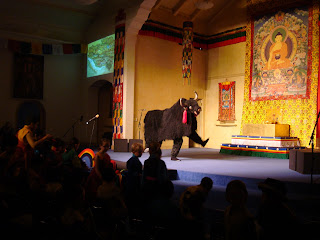
The children file into the theater, preceded by a hilarious dancing yak. I once spoke with a Tibetan rinpoche (an esteemed spiritual teacher) who told me how uproariously funny it is for Tibetans when they hear Americans speak of “yak butter.” It seems the word “yak” denotes the male animal only. The female is called dri or nak.

Below, the young Lhamo Dhondup is formally recognized as the reincarnation of the 13th Dalai Lama, Thubten Gyatso. In this scene, he successfully passes his examination by a panel of senior monks, by correctly choosing among an assortment of objects the possessions of his former incarnation. The Dalai Lama is believed to be the rebirth of a long line of teachers who descend from the bodhisattva (enlightened being) Avalokiteśvara. His Holiness is revered as the latest reincarnation of a series of spiritual leaders who have chosen to be reborn for the purpose of enlightening others.

The young student, having received the monastic name Tenzin Gyatso, begins his formal studies at the age of six. In this scene, he passes an early examination, in preparation for assuming his role as the spiritual leader of the Tibetan people.

In this photo, the Dalai Lama, in his late teens, conducts the funeral ceremony for his father, the head of a farming family in northeastern Tibet.

Below: As Tibet feels increasingly threatened by China, it asks other nations for help. Here, the leaders of the America, Great Britain, Pakistan, and India make their excuses —their unspoken message, that they fear to offend China, a rising superpower. A remarkable feature of the performance was that no matter where you stood in the fairly large hall, you could understand every word spoken by the players —a tribute to the children’s diction and poise, and to school director Helen Purcell’s masterful control of the sound system.

Next: An evil spirit casts a shadow over Tibet, foreshadowing the tragic events that would follow. Notice the wonderful Tibetan wall hanging, which was loaned for the performance by a respected Tibetan spiritual teacher.

The People’s Army invades the land. During the takeover, 1,200,000 Tibetans would die at the hands of the Chinese military.

Below, the Dalai Lama meets with Chairman Mao, whose “pretty words do not mirror the evil that is in his heart.”

In 1959, as the Tibetan people demonstrate against the Chinese occupation, senior monks meet with the Dalai Lama to decide what to do.

Below: Brutal suppression of the Uprising of 1959. Throughout these terrible events, the Dalai Lama was unwavering in his compassion even toward the soldiers who murdered his people. “I am a simple monk from Tibet,” he declared.

Final bows and a standing ovation, after an amazing performance.

In the next photo, taken following the first performance on Wednesday morning, a group of Tibetan monks meet with the children and school director Helen Purcell. The leader of the monks was so moved by the event that he was unable to speak for a time. He then invited the students and teachers to be his personal guests at the Dalai Lama’s public appearance in San Jose, in October 2010.

Final thoughts: As inspiring as the play was, its value as entertainment pales before its significance of its contribution to these young people’s lives.
School director Helen Purcell describes the rich learning experiences for the children during the six weeks they spend preparing for the play:
Living Wisdom School includes the junior high years, when the quality of will power assumes center stage in their development, as they prepare to for independent adult life. The junior high actors generally play the more mature characters, who express qualities of wisdom and inner strength. Middle-school teacher Gary McSweeney talks about this aspect of the plays:
On the morning of the second performance of Living Wisdom School's Dalai Lama play, I arrived an hour early. Having had long experience with the annual plays, I was confident that the behind-stage scenes would be almost as colorful and interesting as the production itself. And I wasn’t disappointed. When I climbed the stairs to the second-floor classroom of the new school building, I found a group of young Tibetan nuns in costume, quietly absorbed in a story that was being read by an older student.

This photo speaks volumes about Living Wisdom School. It illustrates the free-form integration of the grades at the school, as older students occasionally mix with the younger ones, serving as role models and impromptu “teacher’s aides.” Both groups of children benefit from this interaction —the younger ones absorb the mature attitudes of the older students, and the older ones experience the joy of helping the younger ones, while feeling a useful, responsible part of the life of the school.
In this next photo, a group of Tibetan monks talk together, 30 minutes before the start of the play. Quite frankly, at their age I suspect that I’d have been frantically trying to remember my lines, and perhaps shaking a bit at the prospect of going on stage and playing an important part before an audience of several hundred adults and children. But these monks were completely relaxed, even though the two older boys in the picture played the lead role of the Dalai Lama at different stages of his life.

Young postulant monks relax, 10 minutes before the opening curtain, while teacher Mathew Sloan talks about the qualities of a successful actor —poise, confidence, focus, and relaxation.

In this photo, drama teacher Mathew Sloan leads the children in a rafter-shaking, rousing song about positive attitudes and joy. Adults who are familiar with Living Wisdom School are forever commenting about the differences with their own early school years. I can tell you for sure that in my own grade school, there would have been a certain restlessness while we sang the essentially meaningless songs of the day —Old McDonald, She’ll Be Coming ‘Round the Mountain, O Susanna, etc. These young scholars were wholly “into” the music, which was about spiritual attitudes that are very real and meaningful.

Below, female dancers in fancy dress check their costumes and share a laugh, just before entering the theater. Do they seem nervous? Lacking in poise? I can’t understand it — how can it be? It must be something they’ve learned at Living Wisdom School.

The play opens to a packed house, as Tibetan dancers bless the theater and invoke auspicious blessings to the performance, the audience, and the performers.

The children file into the theater, preceded by a hilarious dancing yak. I once spoke with a Tibetan rinpoche (an esteemed spiritual teacher) who told me how uproariously funny it is for Tibetans when they hear Americans speak of “yak butter.” It seems the word “yak” denotes the male animal only. The female is called dri or nak.


Below, the young Lhamo Dhondup is formally recognized as the reincarnation of the 13th Dalai Lama, Thubten Gyatso. In this scene, he successfully passes his examination by a panel of senior monks, by correctly choosing among an assortment of objects the possessions of his former incarnation. The Dalai Lama is believed to be the rebirth of a long line of teachers who descend from the bodhisattva (enlightened being) Avalokiteśvara. His Holiness is revered as the latest reincarnation of a series of spiritual leaders who have chosen to be reborn for the purpose of enlightening others.

The young student, having received the monastic name Tenzin Gyatso, begins his formal studies at the age of six. In this scene, he passes an early examination, in preparation for assuming his role as the spiritual leader of the Tibetan people.

In this photo, the Dalai Lama, in his late teens, conducts the funeral ceremony for his father, the head of a farming family in northeastern Tibet.

Below: As Tibet feels increasingly threatened by China, it asks other nations for help. Here, the leaders of the America, Great Britain, Pakistan, and India make their excuses —their unspoken message, that they fear to offend China, a rising superpower. A remarkable feature of the performance was that no matter where you stood in the fairly large hall, you could understand every word spoken by the players —a tribute to the children’s diction and poise, and to school director Helen Purcell’s masterful control of the sound system.

Next: An evil spirit casts a shadow over Tibet, foreshadowing the tragic events that would follow. Notice the wonderful Tibetan wall hanging, which was loaned for the performance by a respected Tibetan spiritual teacher.

The People’s Army invades the land. During the takeover, 1,200,000 Tibetans would die at the hands of the Chinese military.

Below, the Dalai Lama meets with Chairman Mao, whose “pretty words do not mirror the evil that is in his heart.”

In 1959, as the Tibetan people demonstrate against the Chinese occupation, senior monks meet with the Dalai Lama to decide what to do.

Below: Brutal suppression of the Uprising of 1959. Throughout these terrible events, the Dalai Lama was unwavering in his compassion even toward the soldiers who murdered his people. “I am a simple monk from Tibet,” he declared.

Final bows and a standing ovation, after an amazing performance.

In the next photo, taken following the first performance on Wednesday morning, a group of Tibetan monks meet with the children and school director Helen Purcell. The leader of the monks was so moved by the event that he was unable to speak for a time. He then invited the students and teachers to be his personal guests at the Dalai Lama’s public appearance in San Jose, in October 2010.

Final thoughts: As inspiring as the play was, its value as entertainment pales before its significance of its contribution to these young people’s lives.
School director Helen Purcell describes the rich learning experiences for the children during the six weeks they spend preparing for the play:
The play is part of the landscape of learning that is offered to the children in our school. They are learning about art, they’re reading poetry, studying geography, and placing it all in space and time, in abstraction and concreteness. The theater experience is completely vivid to them —it enables the children to make endless fresh connections. It’s the deepest kind of learning. It isn’t isolated from traditional academic classroom work. But it’s experiential, and its lessons go bone-deep.Every child in the school plays a role in the play, whether as a five-year-old dancing in a crowd scene, an eighth-grader playing the Dalai Lama, or a third-grader speaking as Prime Minister Margaret Thatcher.
Living Wisdom School includes the junior high years, when the quality of will power assumes center stage in their development, as they prepare to for independent adult life. The junior high actors generally play the more mature characters, who express qualities of wisdom and inner strength. Middle-school teacher Gary McSweeney talks about this aspect of the plays:
The teens are a time when children naturally want to find people they can look up to. They want heroes.... In our school, we introduce them to hero figures primarily through the all-school theater production, where each child in the school takes part.
The students are learning about a specific period and the life of a great soul such as Buddha, Christ, Krishna, Moses, Kwan Yin, Rumi, or St. Francis. As the play approaches, we go deeply into the history, culture, and thought of the period, as well as the teachings of the subject of the play. The students’ lines are the words of great souls. So it’s experiential.
While preparing for the play, they have many hours of instruction in how to act their part. We give them tremendous support. But, come performance, the bottom line is that I won’t be there. So it’s an intense, real experience that challenges them to draw on something within themselves to put on four performances to an audience of several hundred adults, teachers, and students from visiting schools.
The plays have an added element, in that the subjects are among the greatest people who have ever lived. They’re people who haven’t chosen the average life. St. Francis abandoned his family’s wealth to follow a higher ideal. Buddha abandoned wealth and family. Christ endured great trials. So they’re exposed to the tests and triumphs of these great souls, and the guidelines they’ve left us for a successful life.
Subscribe to:
Posts (Atom)

Home · Calendar · Classes & Events · Meditation · Yoga · Sundays · Music · Audio/Video Talks · Donate/Support Ananda · Site Map · About Us · Signup for news · Contact/Find Us
Ananda Sangha, 2171 El Camino Real, Palo Alto, CA 94306, (650) 323-3363
Serving the San Francisco Bay Area, including the Peninsula, Silicon Valley, and San Jose, CA
© 2013 Ananda