


David Eby, music director for Ananda, came down from the Village last weekend to give a couple of workshops on "The Sacred Art of Singing," and "Music, Inspiration, and Consciousness." He also played cello and led the choir at Sunday Service, and Ron got us a video of it. Enjoy!
Musical Selections 5/23/2010 from Ananda Palo Alto on Vimeo.
Ananda Family News
Monday, May 24, 2010
Friday, May 21, 2010
Happy Birthday, Swamiji!
May 19th was Swami Kriyananda's 84th birthday. Our celebration on Wednesday evening began with — what else? — a group meditation. Following that, we got to bask in Swamiji's music, both performed by our choir, and on recordings of Swami himself singing. The music alternated with Asha reading to us a number of delightful, moving, and inspiring stories from her book, Swami Kriyananda As We Have Known Him. We also watched a short video, from the series of Bhagavad Gita commentaries Swami is doing for Indian television. (You know you can follow along with these on the Ananda YouTube page, right?) All in all, it was a beautiful evening of appreciating what a blessing we have in Swamiji's teaching, friendship, and leadership.
If you visit the "A Place Called Ananda" blog, you can also find recordings of the music from the Ananda Village birthday celebration, and a page full of birthday wishes (which you can add to, if you like).
Happy birthday, Swamiji!


If you visit the "A Place Called Ananda" blog, you can also find recordings of the music from the Ananda Village birthday celebration, and a page full of birthday wishes (which you can add to, if you like).
Happy birthday, Swamiji!

Monday, May 17, 2010
Garden Party for the Garden
 On Sunday after service, we had a High Tea Garden Party on the central lawn at the community. Some 70 or so people attended, ate delicious food, got serenaded by our lovely singers, and raised money for the community gardens.
 A small army of volunteer cooks and bakers prepared a glorious repast. The lunch table included row upon row of quiches (in mushroom and leek varieties), as well as deviled eggs, cucumber sandwiches, nutballs, salad, crackers with blue cheese and raspberry jam, muffins, and maple scones with lemon curd. The dessert table was at least as huge and covered in tastiness that included brownies, chocolate chip cookies, peanut butter cookies, cardamom cookies, lemon cookies, raspberry muffins, chocolate covered strawberries, and six varieties of shortbread. Wow!
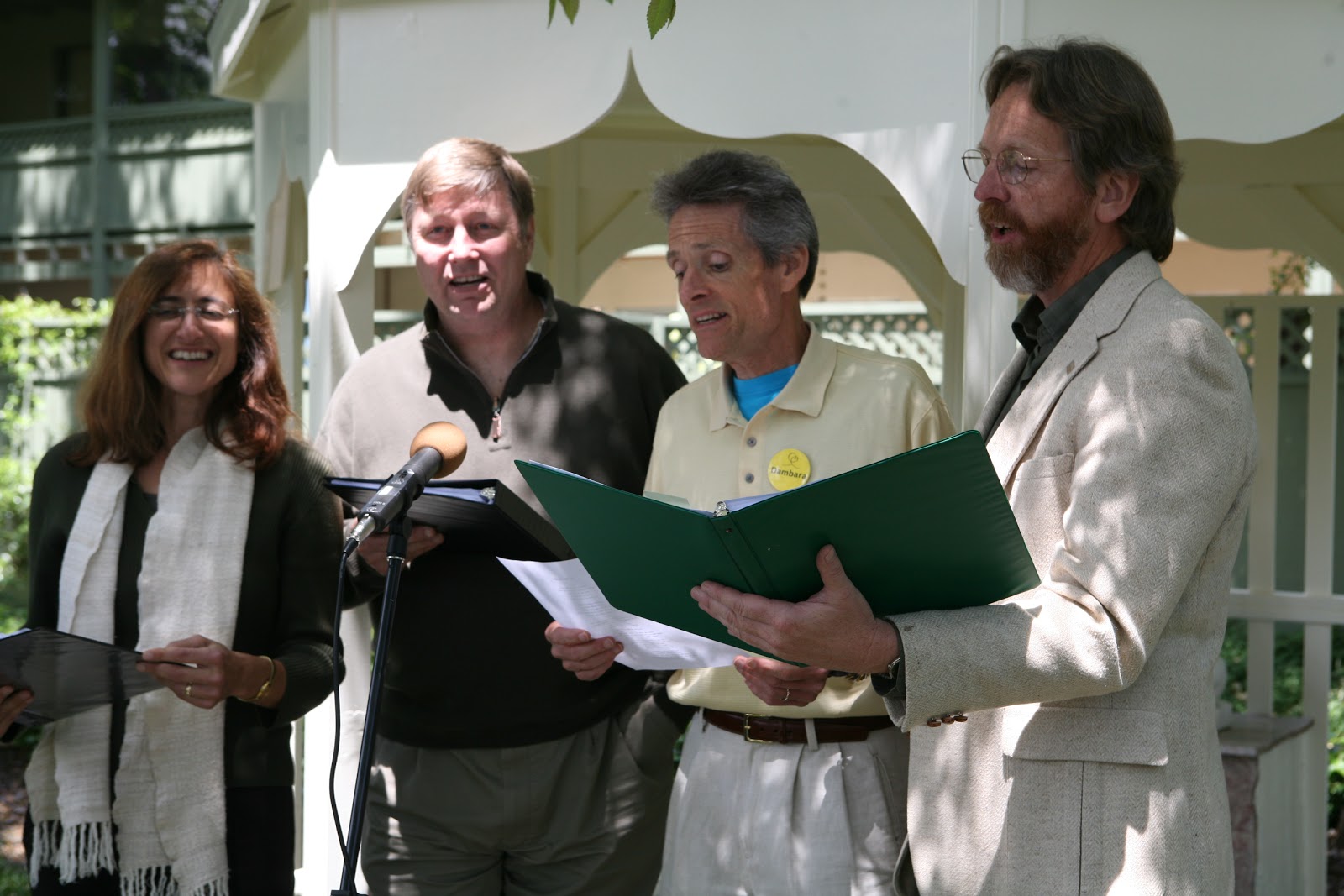 As we ate, different groups of singers occasionally popped up around the tables to entertain us. David P. talked about his recent trip to Italy to see Swamiji, and Amara told us about the community gardens. Did you know that the garden area behind Master's Kitchen used to be a driveway? And the orchard used to be a volleyball court. And now they're full of fruit and veggies!
In the end, we raised over $2,500 for the garden. That money will be used to replace old redwood planter boxes, upgrade the drip watering system, enhance the soil in the orchard for growing vegetables, and purchase seeds. Thank you, everyone who contributed!
 We ended the party with everyone singing "Many Hands Make a Miracle," because they certainly did, with such a beautiful event going so joyfully. And for an encore, the entire crowd of miracle workers tackled the cleanup, causing Asha to remark on how very astral Ananda events always seem to be -- they spring up, practically from nothing, make a lot of people happy, and then just vanish again into the ether.
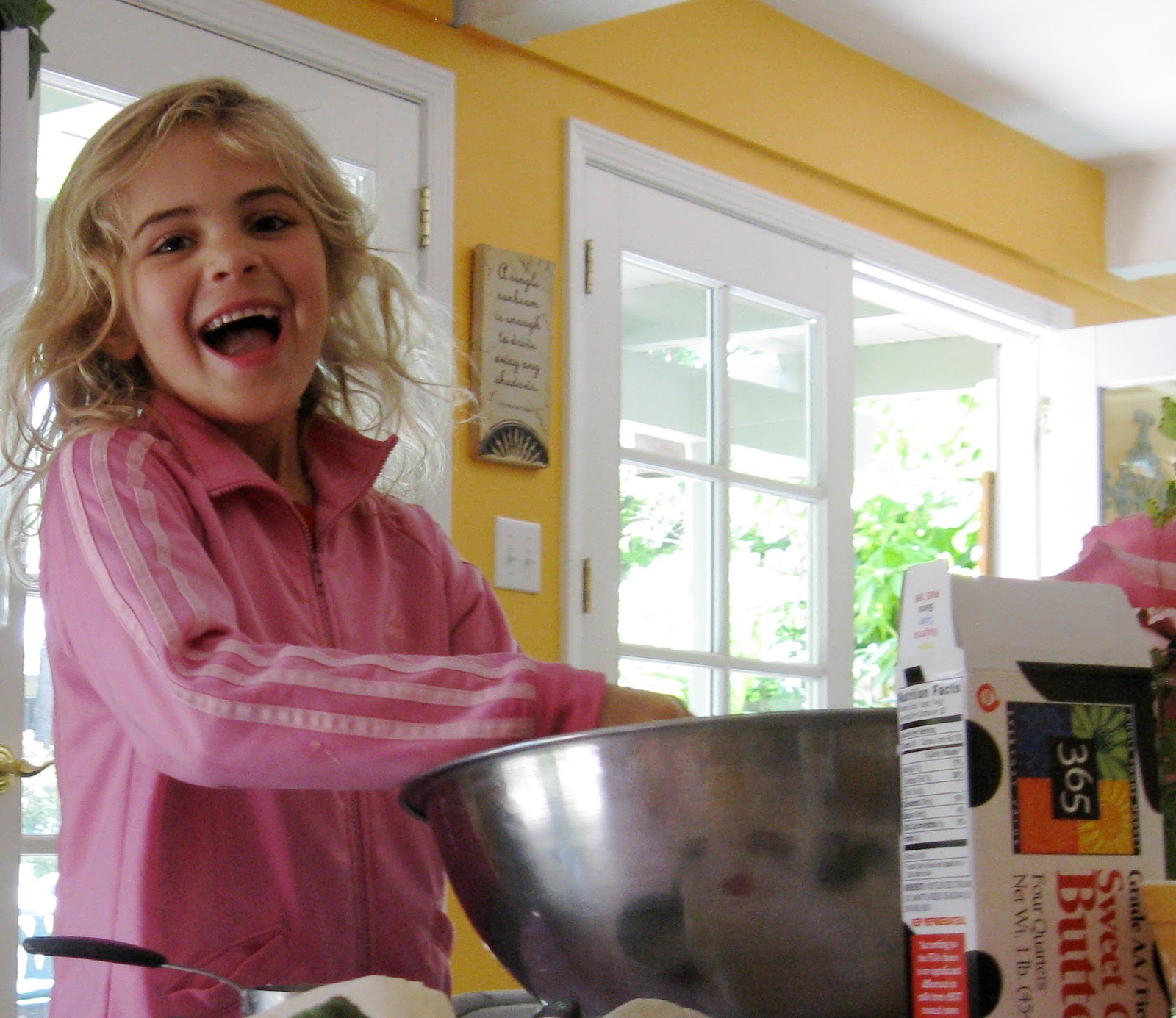
 You can see more photos of the day here. And just for an extra little dose of adorableness, here's a shot of Grace helping make the shortbread cookies on Saturday.
Thursday, May 6, 2010


Friday, April 9, 2010
Easter Videos
Thanks to Ron, we've got some videos from Easter online now. Take a look!
Pavani leads the congregation in the choreography to "Children of God."
Graham, Nirmoha, Trish, Tim, Nishkama, and Cheryl perform "Jeeves and the Impending Doom," by P. G. Wodehouse.
Pavani leads the congregation in the choreography to "Children of God."
Easter Sing 4/4/2010 from Ananda Palo Alto on Vimeo.
Graham, Nirmoha, Trish, Tim, Nishkama, and Cheryl perform "Jeeves and the Impending Doom," by P. G. Wodehouse.
Wodehouse Play 4/4/2010 from Ananda Palo Alto on Vimeo.
Wednesday, April 7, 2010
Living Wisdom School's amazing production of the life of the Dalai Lama
[The following guest post and photos are by Tyagi Rambhakta. You also can see the complete set of photos here.]
On the morning of the second performance of Living Wisdom School's Dalai Lama play, I arrived an hour early. Having had long experience with the annual plays, I was confident that the behind-stage scenes would be almost as colorful and interesting as the production itself. And I wasn’t disappointed. When I climbed the stairs to the second-floor classroom of the new school building, I found a group of young Tibetan nuns in costume, quietly absorbed in a story that was being read by an older student.

This photo speaks volumes about Living Wisdom School. It illustrates the free-form integration of the grades at the school, as older students occasionally mix with the younger ones, serving as role models and impromptu “teacher’s aides.” Both groups of children benefit from this interaction —the younger ones absorb the mature attitudes of the older students, and the older ones experience the joy of helping the younger ones, while feeling a useful, responsible part of the life of the school.
In this next photo, a group of Tibetan monks talk together, 30 minutes before the start of the play. Quite frankly, at their age I suspect that I’d have been frantically trying to remember my lines, and perhaps shaking a bit at the prospect of going on stage and playing an important part before an audience of several hundred adults and children. But these monks were completely relaxed, even though the two older boys in the picture played the lead role of the Dalai Lama at different stages of his life.

Young postulant monks relax, 10 minutes before the opening curtain, while teacher Mathew Sloan talks about the qualities of a successful actor —poise, confidence, focus, and relaxation.

In this photo, drama teacher Mathew Sloan leads the children in a rafter-shaking, rousing song about positive attitudes and joy. Adults who are familiar with Living Wisdom School are forever commenting about the differences with their own early school years. I can tell you for sure that in my own grade school, there would have been a certain restlessness while we sang the essentially meaningless songs of the day —Old McDonald, She’ll Be Coming ‘Round the Mountain, O Susanna, etc. These young scholars were wholly “into” the music, which was about spiritual attitudes that are very real and meaningful.

Below, female dancers in fancy dress check their costumes and share a laugh, just before entering the theater. Do they seem nervous? Lacking in poise? I can’t understand it — how can it be? It must be something they’ve learned at Living Wisdom School.

The play opens to a packed house, as Tibetan dancers bless the theater and invoke auspicious blessings to the performance, the audience, and the performers.

The children file into the theater, preceded by a hilarious dancing yak. I once spoke with a Tibetan rinpoche (an esteemed spiritual teacher) who told me how uproariously funny it is for Tibetans when they hear Americans speak of “yak butter.” It seems the word “yak” denotes the male animal only. The female is called dri or nak.

Below, the young Lhamo Dhondup is formally recognized as the reincarnation of the 13th Dalai Lama, Thubten Gyatso. In this scene, he successfully passes his examination by a panel of senior monks, by correctly choosing among an assortment of objects the possessions of his former incarnation. The Dalai Lama is believed to be the rebirth of a long line of teachers who descend from the bodhisattva (enlightened being) Avalokiteśvara. His Holiness is revered as the latest reincarnation of a series of spiritual leaders who have chosen to be reborn for the purpose of enlightening others.

The young student, having received the monastic name Tenzin Gyatso, begins his formal studies at the age of six. In this scene, he passes an early examination, in preparation for assuming his role as the spiritual leader of the Tibetan people.

In this photo, the Dalai Lama, in his late teens, conducts the funeral ceremony for his father, the head of a farming family in northeastern Tibet.

Below: As Tibet feels increasingly threatened by China, it asks other nations for help. Here, the leaders of the America, Great Britain, Pakistan, and India make their excuses —their unspoken message, that they fear to offend China, a rising superpower. A remarkable feature of the performance was that no matter where you stood in the fairly large hall, you could understand every word spoken by the players —a tribute to the children’s diction and poise, and to school director Helen Purcell’s masterful control of the sound system.

Next: An evil spirit casts a shadow over Tibet, foreshadowing the tragic events that would follow. Notice the wonderful Tibetan wall hanging, which was loaned for the performance by a respected Tibetan spiritual teacher.

The People’s Army invades the land. During the takeover, 1,200,000 Tibetans would die at the hands of the Chinese military.

Below, the Dalai Lama meets with Chairman Mao, whose “pretty words do not mirror the evil that is in his heart.”

In 1959, as the Tibetan people demonstrate against the Chinese occupation, senior monks meet with the Dalai Lama to decide what to do.

Below: Brutal suppression of the Uprising of 1959. Throughout these terrible events, the Dalai Lama was unwavering in his compassion even toward the soldiers who murdered his people. “I am a simple monk from Tibet,” he declared.

Final bows and a standing ovation, after an amazing performance.

In the next photo, taken following the first performance on Wednesday morning, a group of Tibetan monks meet with the children and school director Helen Purcell. The leader of the monks was so moved by the event that he was unable to speak for a time. He then invited the students and teachers to be his personal guests at the Dalai Lama’s public appearance in San Jose, in October 2010.

Final thoughts: As inspiring as the play was, its value as entertainment pales before its significance of its contribution to these young people’s lives.
School director Helen Purcell describes the rich learning experiences for the children during the six weeks they spend preparing for the play:
Living Wisdom School includes the junior high years, when the quality of will power assumes center stage in their development, as they prepare to for independent adult life. The junior high actors generally play the more mature characters, who express qualities of wisdom and inner strength. Middle-school teacher Gary McSweeney talks about this aspect of the plays:
On the morning of the second performance of Living Wisdom School's Dalai Lama play, I arrived an hour early. Having had long experience with the annual plays, I was confident that the behind-stage scenes would be almost as colorful and interesting as the production itself. And I wasn’t disappointed. When I climbed the stairs to the second-floor classroom of the new school building, I found a group of young Tibetan nuns in costume, quietly absorbed in a story that was being read by an older student.

This photo speaks volumes about Living Wisdom School. It illustrates the free-form integration of the grades at the school, as older students occasionally mix with the younger ones, serving as role models and impromptu “teacher’s aides.” Both groups of children benefit from this interaction —the younger ones absorb the mature attitudes of the older students, and the older ones experience the joy of helping the younger ones, while feeling a useful, responsible part of the life of the school.
In this next photo, a group of Tibetan monks talk together, 30 minutes before the start of the play. Quite frankly, at their age I suspect that I’d have been frantically trying to remember my lines, and perhaps shaking a bit at the prospect of going on stage and playing an important part before an audience of several hundred adults and children. But these monks were completely relaxed, even though the two older boys in the picture played the lead role of the Dalai Lama at different stages of his life.

Young postulant monks relax, 10 minutes before the opening curtain, while teacher Mathew Sloan talks about the qualities of a successful actor —poise, confidence, focus, and relaxation.

In this photo, drama teacher Mathew Sloan leads the children in a rafter-shaking, rousing song about positive attitudes and joy. Adults who are familiar with Living Wisdom School are forever commenting about the differences with their own early school years. I can tell you for sure that in my own grade school, there would have been a certain restlessness while we sang the essentially meaningless songs of the day —Old McDonald, She’ll Be Coming ‘Round the Mountain, O Susanna, etc. These young scholars were wholly “into” the music, which was about spiritual attitudes that are very real and meaningful.

Below, female dancers in fancy dress check their costumes and share a laugh, just before entering the theater. Do they seem nervous? Lacking in poise? I can’t understand it — how can it be? It must be something they’ve learned at Living Wisdom School.

The play opens to a packed house, as Tibetan dancers bless the theater and invoke auspicious blessings to the performance, the audience, and the performers.

The children file into the theater, preceded by a hilarious dancing yak. I once spoke with a Tibetan rinpoche (an esteemed spiritual teacher) who told me how uproariously funny it is for Tibetans when they hear Americans speak of “yak butter.” It seems the word “yak” denotes the male animal only. The female is called dri or nak.


Below, the young Lhamo Dhondup is formally recognized as the reincarnation of the 13th Dalai Lama, Thubten Gyatso. In this scene, he successfully passes his examination by a panel of senior monks, by correctly choosing among an assortment of objects the possessions of his former incarnation. The Dalai Lama is believed to be the rebirth of a long line of teachers who descend from the bodhisattva (enlightened being) Avalokiteśvara. His Holiness is revered as the latest reincarnation of a series of spiritual leaders who have chosen to be reborn for the purpose of enlightening others.

The young student, having received the monastic name Tenzin Gyatso, begins his formal studies at the age of six. In this scene, he passes an early examination, in preparation for assuming his role as the spiritual leader of the Tibetan people.

In this photo, the Dalai Lama, in his late teens, conducts the funeral ceremony for his father, the head of a farming family in northeastern Tibet.

Below: As Tibet feels increasingly threatened by China, it asks other nations for help. Here, the leaders of the America, Great Britain, Pakistan, and India make their excuses —their unspoken message, that they fear to offend China, a rising superpower. A remarkable feature of the performance was that no matter where you stood in the fairly large hall, you could understand every word spoken by the players —a tribute to the children’s diction and poise, and to school director Helen Purcell’s masterful control of the sound system.

Next: An evil spirit casts a shadow over Tibet, foreshadowing the tragic events that would follow. Notice the wonderful Tibetan wall hanging, which was loaned for the performance by a respected Tibetan spiritual teacher.

The People’s Army invades the land. During the takeover, 1,200,000 Tibetans would die at the hands of the Chinese military.

Below, the Dalai Lama meets with Chairman Mao, whose “pretty words do not mirror the evil that is in his heart.”

In 1959, as the Tibetan people demonstrate against the Chinese occupation, senior monks meet with the Dalai Lama to decide what to do.

Below: Brutal suppression of the Uprising of 1959. Throughout these terrible events, the Dalai Lama was unwavering in his compassion even toward the soldiers who murdered his people. “I am a simple monk from Tibet,” he declared.

Final bows and a standing ovation, after an amazing performance.

In the next photo, taken following the first performance on Wednesday morning, a group of Tibetan monks meet with the children and school director Helen Purcell. The leader of the monks was so moved by the event that he was unable to speak for a time. He then invited the students and teachers to be his personal guests at the Dalai Lama’s public appearance in San Jose, in October 2010.

Final thoughts: As inspiring as the play was, its value as entertainment pales before its significance of its contribution to these young people’s lives.
School director Helen Purcell describes the rich learning experiences for the children during the six weeks they spend preparing for the play:
The play is part of the landscape of learning that is offered to the children in our school. They are learning about art, they’re reading poetry, studying geography, and placing it all in space and time, in abstraction and concreteness. The theater experience is completely vivid to them —it enables the children to make endless fresh connections. It’s the deepest kind of learning. It isn’t isolated from traditional academic classroom work. But it’s experiential, and its lessons go bone-deep.Every child in the school plays a role in the play, whether as a five-year-old dancing in a crowd scene, an eighth-grader playing the Dalai Lama, or a third-grader speaking as Prime Minister Margaret Thatcher.
Living Wisdom School includes the junior high years, when the quality of will power assumes center stage in their development, as they prepare to for independent adult life. The junior high actors generally play the more mature characters, who express qualities of wisdom and inner strength. Middle-school teacher Gary McSweeney talks about this aspect of the plays:
The teens are a time when children naturally want to find people they can look up to. They want heroes.... In our school, we introduce them to hero figures primarily through the all-school theater production, where each child in the school takes part.
The students are learning about a specific period and the life of a great soul such as Buddha, Christ, Krishna, Moses, Kwan Yin, Rumi, or St. Francis. As the play approaches, we go deeply into the history, culture, and thought of the period, as well as the teachings of the subject of the play. The students’ lines are the words of great souls. So it’s experiential.
While preparing for the play, they have many hours of instruction in how to act their part. We give them tremendous support. But, come performance, the bottom line is that I won’t be there. So it’s an intense, real experience that challenges them to draw on something within themselves to put on four performances to an audience of several hundred adults, teachers, and students from visiting schools.
The plays have an added element, in that the subjects are among the greatest people who have ever lived. They’re people who haven’t chosen the average life. St. Francis abandoned his family’s wealth to follow a higher ideal. Buddha abandoned wealth and family. Christ endured great trials. So they’re exposed to the tests and triumphs of these great souls, and the guidelines they’ve left us for a successful life.
Monday, April 5, 2010
Easter Festivities
 Easter season actually kicked off last week with Palm Sunday, but this weekend was the really busy one. On Good Friday we had an evening service, in which David and Asha got us caught up on the Easter story up to that point (leaving the thrilling conclusion for later, of course). It also included numerous musical selections from Swamiji's Christ Lives! oratorio, and a purification ceremony.
 [Side note: You may have noticed the new image of Jesus on our altar recently. It's been up for a few weeks now, but has been more noticeable recently with the larger version also on display this week. If you're curious about it, it's an artist's rendition based on the shroud of Turin. Swami Kriyananda quite likes it (as do others), and Asha has pointed out how well the eyes match Yogananda's.]
 On Saturday morning we had the annual Easter Oratorio retreat. This wasn't a performance, but more of a spiritual sing-along for everyone to join in, regardless of singing experience (words and music provided). We all sat right up by the altar, facing the large picture of Jesus, and sang the Christ Lives! oratorio all the way through. There were a few breaks for meditation and for Asha to share some commentary. It was a lovely way to experience both the music and the story.
And then Sunday, of course, was the big day itself. Asha finished the Easter story during service (spoiler: the hero lives!) and then we transformed the temple into a banquet hall. Shanti and Sharmila, I believe, were the main coordinators of what was probably a massive number of cooks and other volunteers, who turned out a gloriously tasty and nourishing Easter brunch for us all.

More Easter pictures can be seen here, courtesy of Karen. Happy springtime, everyone!
Subscribe to:
Posts (Atom)

Home · Calendar · Classes & Events · Meditation · Yoga · Sundays · Music · Audio/Video Talks · Donate/Support Ananda · Site Map · About Us · Signup for news · Contact/Find Us
Ananda Sangha, 2171 El Camino Real, Palo Alto, CA 94306, (650) 323-3363
Serving the San Francisco Bay Area, including the Peninsula, Silicon Valley, and San Jose, CA
© 2013 Ananda